Showing posts with label genre: fantasy. Show all posts

Sunday, September 22, 2013

Wolfsbane Winter by Jane Fletcher


Wolfsbane Winter by Jane Fletcher
Bold Strokes Books, 2010.


Overview: In the land of Galvonia, we meet Deryn, a female mercenary (a.k.a. an Iron Wolf) who has serious attachment issues due to her tragic past, and Alana, a member of the demon-spawn nobility with a semi-legitimate fear of starting a romantic relationship with a commoner. (Yes, I’m serious—demon-spawn.) Deryn and Alana’s paths cross about 100 pages into the 254 page book, and the rest of the book details their struggles to maintain their defenses in the face of extreme sexual attraction.

My reaction: While this was definitely as ridiculous as I was expecting a paperback romance to be, it was a quick and enjoyable read. There were plot points that pushed my ability to suspend my disbelief to the limit, demon-spawn politics fell into the unfortunate category of “Too-fleshed-out-to-be-forgotten-yet-too-spare-to-be-anything-more-than-semi-annoying-and/or-tantalizing.” I guess that I got a kick out of seeing how little the nobility’s antics affected commoners, but that made the slimy king’s counselor’s machinations pretty irrelevant. The sex scenes are kind of absurd and remarkably scarce, considering that the first sentence of the blurb on the back cover is “The Iron Wolf mercenaries who guard travelers on the Misery Trail are notorious for their quick and casual sex lives.” However, they’re perfect for a good read-aloud/laugh, and I will give Fletcher credit—I actually wanted Deryn and Alana together, and genuinely rooted for them through my laughter. 

Saturday, June 29, 2013

Forged in Fire by J.A. Pitts

Forged in Fire by J.A. Pitts
A Tor Book published by Tom Doherty Associates, LLC, 2012.

Overview: Sarah Beauhall continues to deal with the fall-out of the dragon-slaying she accomplished in Black Blade Blues, picking up right where Honeyed Words left off. A bloodthirsty necromancer is on the loose, and while he has taken a distressing interest in killing off Sarah's acquaintances, he is definitely trying to achieve something even more terrible.

My reaction: Forged in Fire thankfully moves much faster and with more direction than Honeyed Words, but it did not quite equal Black Blade Blues for me. Since we jump right into an action sequence in the first pages, I thought it was going to really show off Sarah's skill with a hammer and sword. Unfortunately, a lot of the action remains on the periphery of her life, and it began to irk me. In my book, if some of your favorite acquaintances are brutally slaughtered for the express purpose of finding out more information from you, AND you have the battle skills to do something about it, YOU TRY TO FIND THE EVIL NECROMANCER. On the whole, though, I was mostly engaged as I enjoyed Katie coming into her own as a heroine herself, and speculating at how Sarah's association with a dragon was going to work out. While I didn't see any hint of another installment coming on his website (which was last updated before Forged in Fire was released!), there were some major loose ends that I anticipate will be taken up if there is one. (Based on the interval between the first three, it shouldn't be too much longer.) I have to admit that I hope there is one, despite the mixed bag of its predecessors, as those loose ends have the potential to be a really good story. 

Saturday, June 22, 2013

Honeyed Words by J.A. Pitts (2nd book in the Sarah Beauhall series)

Honeyed Words by J.A. Pitts
Tor Books, 2011. 


Overview: At the beginning of Honeyed Words, Sarah and her friends are only a few months removed from the traumatic battle with a dragon and his minions, and are struggling to forgive themselves and each other for the deaths of their comrades. When an acquaintance is kidnapped by dwarves, Sarah is alerted to the unrest in Vancouver, the former domain of the dragon she slew. While she assesses the new threats to the safety of her circle, Sarah must also find a way to reconcile with friends and enemies alike. 

My reaction: I was really disappointed in this one overall. While the first one had some plot holes, the story was generally moving fast enough for me to not really care; Honeyed Words moved about as fast as molasses until at least halfway in. Part of that was because of  excessive summarization of Black Blade Blues, but I also couldn't really get invested in the kidnapping arc. I didn't miss it when it got dropped (well, as in Sarah wasn't actively trying to rescue him) for most of the book in favor of focusing on a more interesting new character's problems, and the unlikely alliances that Sarah forges to help her. Like Sarah, I was relieved when there was something for her to do about the situation. Unfortunately, that took a little too long for it to be as rewarding as Black Blade Blues.

I wanted to finish the next book, Forged in Fire, to balance out this review, since the 58 pages I've read so far are much better, but I didn't have the time. I hope that it maintains its fast pace, since I'll feel better about sticking with Honeyed Words if there is a payoff in Forged.

(I was tempted by the end to give this a "decent," but I think that's more a reflection on the relative quality of its companions than on its own merits.)

Friday, June 14, 2013

Black Blade Blues by J.A. Pitts

Black Blade Blues by J.A. Pitts
Tor Books, 2010.

No, she does not wear belly shirts in the book!
Overview: Sarah Beauhall, a Seattle blacksmith and part-time prop manager for a low-budget movie, is happy to spend her free time with her friends in the Society for Creative Anachronism (a medieval re-enactment group), going to auctions to pick up antique weapons, and dating her girlfriend of a year, Katie. When she comes into possession of a sword straight out of Norse myth, Sarah is forced to recognize that dragons, giants, and trolls are real, and that she must fight them. 

My reactionWhen I found this in the library, I thought it was too good to be true! Tamora Pierce's Daja Kisubo, a female blacksmith who (spoiler alert!) is eventually revealed to be attracted to the ladies, was the beginning of my love for lesbian smiths, and Laurie J. Marks' Karis rekindled it. With Black Blade Blues, I hoped to find another kickass smith to be a fan of. For the most part, Sarah did not disappoint! She is a skilled smith and warrior (she's proficient in tae kwon do as well as sword and hammer), and while she is a skeptic at first, she commits herself to saving the day when her friends are in danger. 

The culminating battle was a thrill to read, and I'm definitely planning to read the other two books in the series, Honeyed Words and Forged in Fire.
My main issue was Sarah's trouble dealing with a really homophobic upbringing. It wasn't her shit-ton of internalized homophobia going on that grated as much as the fact that she recognized it, and hadn't taken constructive steps to deal with it even as it sabotaged her relationship with the woman of her dreams. When it got too much, I'd skim just slow enough to comprehend, but fast enough that my annoyance was minimized. 

Since this was my first urban fantasy read featuring a lesbian blacksmith in the Pacific Northwest, and I was really enjoying my reintroduction to the genre after a long time spent reading mysteries, I brushed aside any number of plot holes without caring too much. It actually wasn't until I was looking up the publishing information for the book on Goodreads--and subsequently gave into the temptation to read negative reviews--that I realized just how thoroughly I had glossed  them over by the end because DRAGONS and HARROWING ENCOUNTERS and oh, yeah, a LESBIAN BLACKSMITH. Sure, there are things that don't make sense, but you know what? I enjoyed it anyway. Yell at the characters a little if you have to (I'm sure you will--I did!), skim a little if you have to, but because my overall enjoyment factor was so high, I'm recommending this one!

Saturday, May 25, 2013

Kissing the Witch by Emma Donoghue


Kissing the Witch by Emma Donoghue
Joanna Cotler Books (Imprint of HarperCollins), 1997

Overview: Kissing the Witch is a collection of thirteen lesbian/feminist retellings of classic fairy tales. Though each is self-contained, the stories also form a cyclical narrative which builds as a minor character from the previous story tells a story of her own.

My Reaction: I’m a fairy tale nut, so Kissing the Witch was right up my alley. Classic Grimms’ Kinder- und Hausmärchen AND lesbians? I’m in! Donoghue did not disappoint. While retaining enough essence of the familiar stories, she highlighted the strong relationships between women already present in many fairy tales, while subverting the paradigm that all powerful women must feel animosity towards each other (think Snow White and her stepmother, who are bitter rivals in any familiar recounting of the story, but here are recast as lovers). Donoghue’s interconnected format allows for those who often have no backstory, such as stepmothers, fairy godmothers or even Beauty’s Beast (remade into a woman) to recount their histories.

Not all of these stories are for the faint of heart; like the original Grimms’ tales, many contain disturbing violence or hints of incest. While it can be easy to ignore disturbing images told in the often deceptively simple voice of fairy tale narrative (which Donoghue captures well), some aspects might not sit well with everyone. Also like fairy tales, you almost have to read between the lines for the romance – you won’t find any heart-pounding scenes of passion. However, I definitely would argue for Kissing the Witch’s inclusion here, even sans overt romance or discussion of sexuality for the way it sensitively highlights the strong attractions between women.

Another reason why I liked this book is that it reminds me of The Rose and the Beast by Francesca Lia Block, another collection of re-spun fairy tales (though not queer), that were important to me as a teenager. Like that book, Kissing the Witch might also appeal to a YA audience, especially those who love fairy tales, but want ones that celebrate strong and courageous women. 

Saturday, April 13, 2013

Mistress of Dragons by Margaret Weis

Mistress of Dragons by Margaret Weis
Tor Books, 2003.

Overview: Mistress of Dragons tells the story of a High Priestess named Melisande (George R.R. Martin, did you rip this name off?), which, for the curious, is apparently derived from Old French and Old German, and originally meant "animal strength." Huh.  Melisande is gifted in dragon magic, which she and her fellow priestesses use to repel dragons that try to invade their kingdom. Draconas, a "walker"--a dragon with human form--and Braun, a dragon-shaped dragon, suspect that a renegade dragon has taken control of Melisande's kingdom, and cleverly enlist the help of a neighboring king to investigate.


My reaction: Overall, this was a decent read. There were some excellent plot twists, and I enjoyed that the cover art made Melisande's temple warrior lover, Bellona (which means "goddess of battle" and is derived from Latin), look similar to Xena, but for some reason I just didn't connect enough with it to be really motivated to read the rest of the trilogy. Maybe it was the heavy-handed exposition at the beginning, or my resentment over a rather yucky manipulation of the king and Melisande, and and even more disturbing/horrifying scene with an evil dragon...I can't really finger it as any one thing. Honestly, this was pretty close to decent because it did keep me reading and the plot twists both made sense and surprised me, but a couple of scenes and my general indifference to the next books downgrade it to "meh."

P.S.--I used the scholarly source thinkbabynames.com to research the name definitions. URLs are below:


Saturday, March 30, 2013

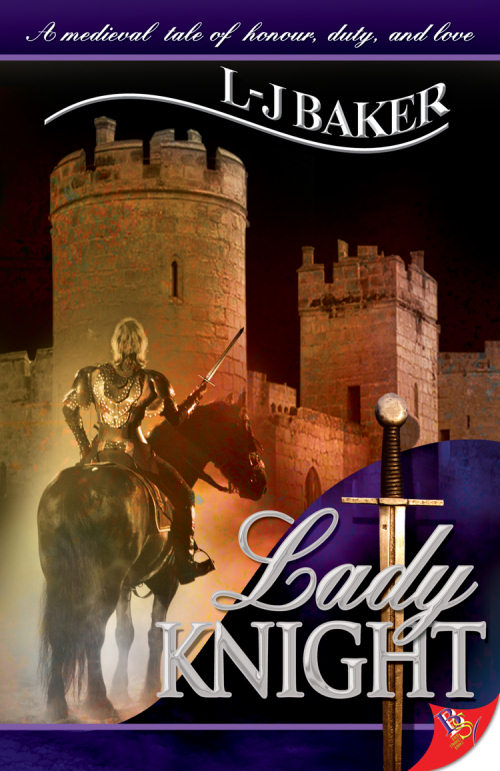
Lady Knight by L-J Baker

Lady Knight by L-J Baker

Bold Strokes Books, Inc., 2007.


Overview: Lady Knight is set in a pseudo-Europe where Crusaders for a religion with four gods have to contend with the infidels’ magic swords, and Riannon, a lady knight—who is often criticized for not being much of a lady—and Eleanor, a beautiful, witty, and wealthy widow, can fall madly in love. While this book, more than any other I have read so far, doesn’t meet our criteria of books where being gay isn’t an issue, the main characters are all positive about it, including the one who has to come to terms with her sexuality, which softens the hate from the minor characters a bit.

My reaction: This was a pretty good read. I was a huge fan of the romance, which was front and center for the majority of the book, and was so desperate for them to end up happy together that I actually couldn’t make myself read the last quarter of the book for a little while. That said, the romance is really all that sucked me in. I had a problem with the religious crusade that, while engineered by a somewhat unsavory lesbian high priestess, was left essentially un-criticized. The “infidels” were basically reduced to plot devices with tattooed faces and swords that could cut through armor without even touching the victim, and while I understood that she was a product of her times, I resented Riannon’s unquestioning participation. While it annoyed me on one hand that we didn’t get much world-building detail about the history of the war between the infidels and the “not-Christians” (I read the book, but don’t really know that there was a name for the collective religion of the four gods…), it’s probably for the best in the end since what there was irritated me. More love and sex scenes than war scenes? Sure, I’ll take it! 

Thendara House by Marion Zimmer Bradley


Thendara House by Marion Zimmer Bradley.
 DAW Books, 1983.

Overview: While this is the sequel to Shattered Chain, which I read first, expecting some lesbian action (or at least main-character romance), it could probably be read as a stand-alone novel. Neither is very long, however, so I would recommend reading Shattered Chain first for the full backstory which is recapped in bits and pieces in its sequel. Magdalene Lorne, a Terran Intelligence agent, was raised on Darkover, where she was one of only a handful of Terrans immersed in Darkovan culture. In Thendara House, Magda, who became a sworn Renunciate (or Free Amazon) in Shattered Chain, goes to the Thendara Guild House to complete her six months of training. Renunciates swear an oath not to depend on men for protection, to not marry religiously, not to bear children except in her “own time and season,” to defend herself with force if attacked by force, that all women under the oath will be her sisters, and more. Even the better part of this book is more focused on Magda’s struggles with her training and her oath-mother (that is, the woman who took her oath) Jaelle’s increasing disillusionment with her partner, Peter Haldane, who also happens to be Magda’s ex-husband. Eventually, however, Magda has to come to terms with her sexuality.

My reaction: For the most part, I really enjoyed this book. Following Magda and Jaelle’s experiences of culture shock, and watching interplanetary politics unfold kept me occupied even as I wondered whether this book, too, would not qualify for a review. World-building for the sake of world-building can drive me crazy, but I love it when it is done well. While the reader learns a lot about Darkovan and Terran etiquette, habits, and mores, every detail feels well-integrated into the plot. I do wish Magda hadn’t been quite so uncomfortable with her lesbian sisters and her own sexuality, but I’ll cut her some slack since the Terran Zone is apparently pretty homophobic. I also admit that after I started really rooting for one relationship, it was a little hard at first for me to accept another one. My only other misgiving—and this is pretty major—was the demonization of men. Bradley doesn’t make all men villains, but Jaelle determines, based on her only heterosexual relationship, that men in general, not just Peter, will feel the need to “possess” her. Ugh. I know the patriarchy exists, but it’s not a biological drive! I think that she figures that out at the conclusion, but THAT squicked me out in a way that I can’t discuss without spoiling it. If you’re a fan of world-building, though, I definitely recommend it.

Saturday, March 9, 2013

Gossamer Axe by Gael Baudino


Gossamer Axe by Gael Baudino
Penguin Books, 1990.


Overview: Gossamer Axe tells the story of Chairiste a woman born in sixth-century Ireland who is separated from her lover, Siudb, after seeking out new musical knowledge from the bard in what I started describing to the Lesbrarian as fairy hell. After discovering the nature of said fairy hell, Chairiste is able to use the bard’s own best harp to escape, but she does not manage to bring Siudb with her. We enter the story after Chairiste has spent two centuries plotting and occasionally attempting Siudb’s rescue, which has led her to Denver in 1987, where a portal to fairy hell awaits her assault. Through a harp student, Chairiste—who goes by Christa in modern-day Denver—discovers rock and roll and metal, and recognizes that they are her best hope for saving Siudb. As you can guess, this is a very music-driven book, so if lots of descriptions of music will bore you, this might not be the book for you.

My reactionWhile I wasn’t expecting too much from this book, I was sucked right in. Two centuries of longing for and attempting to rescue a lover? I ate it right up. I’m not even a metal fan, but I was inspired to actually listen to what Baudino described as some of the more “rarefied” stuff—Malmsteen’s “Black Star” was Christa’s introduction—and discovered somewhat to my surprise that I liked it. (Here’s Malmsteen’s “Black Star”: http://www.youtube.com/watch?v=XNOa5Gjh2lc ).  I definitely giggled in a few places that I don’t think I was supposed to, and the unusual number of typos in the second half were sometimes a bit irritating, but overall I was invested in Christa’s fight to save Siudb, and supporting characters’ struggles with their own demons of homophobic/rocker-phobic parents, a sexually abusive father, and drugs. Without trying to spoil anything too badly, I was kind of upset by Christa’s apparently magical vagina which, through (in my opinion) blissfully hardly-described sex allows for the “rebirth” of a male partner. I guess I can grudgingly accept it on a re-read, though it came dangerously close to “I’ll have sex with you because I owe you” for my taste, even though he’s a good friend. On the upside, it doesn’t affect her love and devotion to Siudb in any way. If anyone has any reactions to that plotline (or any others!) I’d be happy to hear them in the comments. Despite my quarrels with it, I stayed with the musical magic/star-crossed lovers elements to the end, and if you can get into a battle-of-the-bards type novel, I recommend it!

Saturday, February 23, 2013

Sing the Four Quarters by Tanya Huff


Sing the Four Quarters by Tanya Huff
Daw Books: 1994

Overview: Ex-princess turned bard Annice has the rare gift of being able to communicate with all four elements through song instead of the usual one or two. However, she has gotten herself into a tight spot by getting pregnant against the king’s express orders, then helping the father of her unborn baby, the Duc of Ohrid (accused of betraying the kingdom of Shkoder) escape from prison. A foul plot is afoot and Annice and her lover Stasya are thrown into the midst of political intrigue that runs deeper than either had imagined. This is the first book in a series of four.

My reaction: If you like political intrigue, magic, elemental spirits, music and a feisty heroine, this book is a fun read. Annice is technically bisexual (she does sleep with the Duc, after all), but it seems pretty clear that Stasya is her main partner. The world in which they live is populated with a number of other queer characters, both male and female. On a completely different note, I don’t think I have ever read a book in which the main character has to pee quite so often, though I suppose that is only realistic, since she is pregnant almost the entire story. In summary, hooray for kick-ass, powerful, pregnant princess-bards!

The Quarters Series:

Sing the Four Quarters, 1994
The Fifth Quarter, 1995
No Quarter, 1996
The Quartered Sea, 1999

Water Logic by Laurie J. Marks


Water Logic by Laurie J. Marks
Small Beer Press, 2007.


Overview: In the third installment of the Elemental Logic Saga, Shaftal is continuing to heal from the decades-long war between the Sainnites and Shaftali. While Karis is established as G’deon of the new government, her rule is still not universally accepted, and Zanja, the ever-faithful wife, crosses yet another boundary (as Marks reminds us in all three books, that is what Zanja DOES) in order to find the way to maintain the tenuous peace brought about by the work of two queer power couples, a Sapphic Sainnite general, and oh, a couple of straight friends who are useful for their healing and truth-telling abilities.

My reactionLOVELOVELOVED. Now that that’s out of the way, let me just say that for all my frustrations with Earth Logic, it was completely worth reading because I love Water Logic so much—possibly more than Fire Logic, where the constant yearning sometimes had me talking to the book telling Karis and Zanja to just kiss already (though of course that meant the payoff when they did was huge, so…). In Water Logic, all of the best characters are able to use their (ele)mental and physical strengths instead of being trapped in inaction, I was deeply invested in the struggle to transform Shaftali and Sainnites into neighbors instead of enemies, and of course, multiple queer romances that are totally accepted without a word are a huge bonus. When I thought beyond the obvious reasons why I love this series, however, I realized that I have hardly ever come across a fantasy universe where the major characters are going to heroic lengths to bring lasting peace to a battle-torn country instead of going out swords glittering in the afternoon sun to defeat the unfortunate underlings of some despicable ruler. Don’t get me wrong, I love George R.R. Martin for the most part, Tamora Pierce’s lady knights still hold a place in my heart, and I can sometimes get so into the intrigue and strategy produced in fantasy books about war that I forget to appreciate the scope of suffering the characters are inflicting/dealing with, but then I stop and feel a little guilty for being entertained by war even if magic/dragons/the characters’ belief in an “acceptable” brand of warfare somehow sanitizes it (obviously, I am not totally unmoved by the particularly horrific violence/crop burning etc. in the Song of Ice and Fire, but it was hard not to root for one army or another, which means being happy at the rout of the opposition...). By making me think more critically about this problem, the Elemental Logic Saga is special beyond its wonderful depiction of queer characters, which is why it was initially included for review.

Maybe the end was a tiny bit schmaltzy, and a MAAAAJOR mysterious/dangerous figure is left largely unexplained and at large, but I’m still in love. The latter complaint, however, makes me a wee bit agitated if I think about it too much and forget that it’s all a fiction—after all, it’s been 5+ years since she published Water Logic! Laurie J. Marks, PLEASE give us Air Logic!!

Earth Logic by Laurie J. Marks


Earth Logic by Laurie J. Marks
Tor Books: 2004

Overview: Earth Logic, the second installment in the Elemental Logic Saga, is devoted to exploring the consequences of allowing a single earth elemental (the G’deon) to harness the power accumulated from the land over centuries. Karis, the G’deon, has to come to terms with possessing the power that she never asked for, and is paralyzed by her understandable concern that she could destroy Shaftal if she were to emerge from obscurity. Since Karis does not permit herself to be a force for change in much of the book, the plot is mostly driven by conflicts between the Sainnites and Shaftali zealots who claim to be followers of the “Lost G’deon,” while inflicting violence against Karis’ wishes. Zanja embarks on a quest to discover how to free Karis to act, and several new characters, including one sexy Sainnite lieutenant commander who gets a ton of page-time! (I wish it were face-time...)

My reaction: While two new characters give us a wonderful new lesbian romance to root for in the nearly-booklong separation of Karis and Zanja, Earth Logic as a whole fell a little short of my (extremely) high expectations for it. Part of that was probably the fact that Fire Logic left me obsessed with Karis and Zanja, and basically just wanting to read about them having a happy life together using their elemental talents for the good of all during the day, and having steamy sex at night (apparently fire and earth talents combine well in bed!) but I also felt some frustration with the major plotline that 


SPOILER ALERTTTTTTTTTTTTTTTTTTTTTTTTTTTTTTTTTT 


rendered Zanja an amnesiac and thus incapable of doing just about anything but telling stories to Sainnite soldiers. Of course, that was not altogether boring, and was important in the grand scheme of things, but I wish she’d been able to express emotions/yearn for Karis because in all my years of reading, I’ve never gotten to see a relationship like mine normalized in fiction, and I wanted more, damn it! (I’ll just be on a comfy futon under a fleece blanket with my laptop pretending that my few years of practicing a martial art--aikido--and my girlfriend’s strong shoulders and short stint of blacksmithing in high school make Zanja and Karis’ experience even more similar to ours...)

Fire Logic by Laurie J. Marks

Fire Logic by Laurie J. Marks
Tor Books: 2002

Overview: Part of a series that will hopefully eventually include four books, Fire Logic follows the story of Zanja, a diplomat turned paladin of sorts in the war-torn land of Shaftal. After her village is attacked by the invading Sainnites, she is taken prisoner and left to rot, until she is rescued by the super buff, half-giant, metalsmith Karis, who has mysterious healing powers and an unfortunate addiction to smoke, a drug that completely deadens her senses. Together with the paladin Emil and a cast of supporting characters, they must find a way to rescue the people of Shaftal before war completely consumes them.


My reaction: Since reading this book, I have become thoroughly obsessed. I’ll admit that the writing was a little difficult to get into at first, and the first few chapters skip through a lot of years, but once I got going, I was hooked. The love story between Zanja and Karis is in parts tragic, in parts extremely sexy and just plain…romantic. I liked that sexuality is never an issue. Not once does anyone comment on any of the characters’ choice of partner; in this world, it appears that people can love whom they please. This allows for the love plot to develop in a way that goes beyond overcoming personal or societal barriers. Yes, they face obstacles to their love, but they are solid fantasy world obstacles. Oh, and the political intrigue is great, as are the meditations on war and peace. I look forward to Karis and Zanja coming more completely into their powers in future installments.

Elemental Logic Series:
Fire Logic, 2002
Earth Logic, 2004
Water Logic, 2007
Air Logic, Forthcoming