Showing posts with label rating: decent. Show all posts

Saturday, December 7, 2013

Slow River by Nicola Griffith


Slow River by Nicola Griffith
Ballantine Books, 1995.

Overview: Slow River, winner of a Lambda Literary Award in 1996, follows the life of Lore van de Oest, a young woman whose pedigree means that she is absurdly wealthy and educated in her family’s “bioremediation” technology. After barely surviving a kidnapping, she is taken in by Spanner, a woman who is perfectly content making a living through crime. While the book begins with Lore’s decision to go “straight” (don’t worry, she still loves ladies, though that is not a huge focus of the book), it constantly flips between the four distinct phases of her life: childhood, the kidnapping, her years with Spanner, and her ongoing attempt to start earning an honest living, albeit under an assumed identity.

My reaction: I feel compelled to start this off with a warning to potential readers that a major part of the story is sexual abuse and rape. It’s not an easy read, to be sure, but putting aside the rape and abuse for a moment, it’s got a lot of my favorite scifi elements: start with a dystopic world that doesn’t seem too far-fetched (i.e., each citizen has an identity chip inserted in the web between their thumb and forefinger), add a mystery, political intrigue, interesting technology (Griffith really goes to town with this one, as she describes in great detail the waste treatment technology that the van de Oest family essentially has a monopoly on), and make it a female protagonist (if she’s a lesbian, bonus points!).

I was pleasantly surprised by how elegantly the plotlines intersected, although I really shouldn’t have been, given that I appreciated Griffith’s skill with story in her other two books (The Blue Place and Ammonite) before picking up Slow River. Her supporting characters felt a little two-dimensional at times, but that could be a manifestation of having a character who was afraid to really engage with them. That said, it didn't keep me from turning the pages and counting the minutes to my lunch break so I could read more. (A review on Ammonite is forthcoming--I loved it, but was too lazy to write a review, and now it's been so long I feel like I should reread it.) Ultimately, however, I think it falls into the high end of my decent category for science fiction, especially when I compare it to Ammonite, which I will definitely recommend. 

More on the rating:  I'm finding that it's much easier to find high quality lesbian science fiction and fantasy than mystery, which is why I gave Griffith's mystery The Blue Place a rating of recommended when I read it. It was a hard decision not to extend the same leeway to Slow River, but in the end, the characters (with the exception of Lore) were just not as real to me as the whole cast of Ammonite.


Sunday, September 15, 2013

Behind the Pine Curtain by Gerri Hill

Behind the Pine Curtain by Gerri Hill
Bella Books, 2006

Overview: Jackie never intended to return to Pine Springs, not after her parents sent her away on a bus after she came out to them. And she never intended to act on her feelings for her best friend Kay, feelings that were her first sign that she was gay all those years ago. But now, upon her father's death, she has no choice bu to return to her childhood home and come face to face with the past she tried so hard to leave behind.

My Reaction: Behind the Pine Curtain has a pretty classic plot: our heroine falls in love with the girl next door and finds that first love is always the best. However, despite some skepticism about the writing (telling us that Kay "stopped breathing" seemed to be one of the author's ticks), I was drawn right into the story, hopeless romantic that I am. If you are a fan of the longing look, a la Jane Austen, there are plenty of those to go around, as well as enough electric touches and colliding eyeballs to keep you guessing when they'll FINALLY KISS ALREADY. Despite a major plot hole/implausible backstory, I still found Hill's book enjoyable. A guilty pleasure, but a pleasure nonetheless.

Saturday, July 20, 2013

Becka's Song by Frankie J. Jones

Becka's Song by Frankie J. Jones
Bella Books, 2008

Overview: Lee Dresher enjoys her quiet life running a successful art gallery in Christmas, Arkansas, where tourists flock every holiday season as the town makes itself over into a Victorian wonderland. She is even happy being single until she meets Becka James who, despite a mysterious and troubled past, might prove too compelling for Lee to ignore.

My Reaction:I was sold on Becka's Song when it opened with Lee hiding in the woods in the early morning, trying to photograph a shy twelve-point buck. Any character that likes nature that much is fine by me. Though the ending fell victim to a few too many cheesy lines, my overall impression of the book confirmed my initial judgment; Becka's Song is a solidly plotted romance with a beautiful setting - a very enjoyable read.

Often, one of my biggest complaints about romances is the lack of convincing characters or plot lines. Here, Jones drew a three-dimensional protagonist, and while the love plot is certainly the center of the book, other occurrences don't feel like they are only there to carry the characters from one sex scene to another. What with Becka's mysterious past and other unsettling events around town, it almost reads like a mystery. A perfect book for a snow day (it is set in Christmas after all, where the holiday season lasts three months), though it works just as well for Christmas in July!

Saturday, June 29, 2013

Forged in Fire by J.A. Pitts

Forged in Fire by J.A. Pitts
A Tor Book published by Tom Doherty Associates, LLC, 2012.

Overview: Sarah Beauhall continues to deal with the fall-out of the dragon-slaying she accomplished in Black Blade Blues, picking up right where Honeyed Words left off. A bloodthirsty necromancer is on the loose, and while he has taken a distressing interest in killing off Sarah's acquaintances, he is definitely trying to achieve something even more terrible.

My reaction: Forged in Fire thankfully moves much faster and with more direction than Honeyed Words, but it did not quite equal Black Blade Blues for me. Since we jump right into an action sequence in the first pages, I thought it was going to really show off Sarah's skill with a hammer and sword. Unfortunately, a lot of the action remains on the periphery of her life, and it began to irk me. In my book, if some of your favorite acquaintances are brutally slaughtered for the express purpose of finding out more information from you, AND you have the battle skills to do something about it, YOU TRY TO FIND THE EVIL NECROMANCER. On the whole, though, I was mostly engaged as I enjoyed Katie coming into her own as a heroine herself, and speculating at how Sarah's association with a dragon was going to work out. While I didn't see any hint of another installment coming on his website (which was last updated before Forged in Fire was released!), there were some major loose ends that I anticipate will be taken up if there is one. (Based on the interval between the first three, it shouldn't be too much longer.) I have to admit that I hope there is one, despite the mixed bag of its predecessors, as those loose ends have the potential to be a really good story. 

Tuesday, June 25, 2013

Cemetery Murders by Jean Marcy

Cemetery Murders by Jean Marcy
New Victoria Publishers, 1997

Overview: A serial killer is at large in St. Louis who targets homeless women and stages their bodies in graveyards. When P.I. Meg Darcy's friend finds her own family caught up in the serial murders, Meg agrees to investigate the case, especially since it means she will get to work with her old army flame, police detective Sarah Lindstrom.

My Reaction: At first I thought Cemetery Murders was going to be a hard-boiled detective novel, along the lines of something by Raymond Chandler, just starring a tomboy lesbian PI. Meg Darcy is perhaps not as hard-boiled as the tone of the first chapter suggests (she only pretends to drink a rum and coke and never wakes up with a hangover), but the book was fun anyway. The mystery kept me guessing and I enjoyed Meg's enthusiastic crush on the mostly aloof Lindstrom. I also suspect someone with greater familiarity with St. Louis than I would enjoy the place specific details scattered throughout the story. I certainly plan on checking out later titles in the series.

On a side note completely unrelated to the quality of the book (but which probably had undue influence over my enjoyment of it), Cemetery Murders was written by the most adorable couple. According to the back:

"Jean Marcy is the combined pen name for Jean Hutchinson [...] and Marcy Jacobs [...]. Partners for nine years, this is the first joint writing endeavor of one who leans towards purple prose and another who sees herself as a minimalist. They live in Illinois"

And here is a picture:


D'awwww

Meg Darcy Mysteries
Cemetery Murders, 1997
Dead and Blonde, 1998
Mommy Deadest, 2000
A Cold Case of Murder, 2003

Sunday, June 2, 2013

Deaths of Jocasta and The Intersection of Law and Desire: Micky Knight mysteries by J.M. Redmann

Deaths of Jocasta by J.M. Redmann
New Victoria Publishers Inc, 1992. Second printing.


Overview: A few months after the events of Death by the Riverside, Dr. Cordelia James hires Micky to investigate some truly ugly hatemail sent to her clinic for women's health. Before too long, Cordelia is implicated in several murders, and Micky has to do her best to prove that her love interest was framed when the police are content to finger the sexy and smart philanthropist for heinous malpractice. Micky perseveres as she is distracted with rocky personal relationships that are complicated by her trust issues stemming from yet more personal trauma in her past.

My reaction: This one was a real thriller, although I almost sped through it just because I had to see the end of the extremely brutal murders. While it was a page-turner for sure, and Micky got herself and others out of several nearly-fatal situations, some of the satisfaction of catching the criminals was taken away by the fact that it was a series of accidents (i.e., they were stupid enough to keep coming after Micky instead of melting away to somewhere she couldn't find them). On the other hand, her tenacity (and the fact that she has nine lives) was impressive, and saved the lives of who knows how many people, and that's always a good ending!


The Intersection of Law and Desire by J.M. Redmann
W.W. Norton & Company, 1995.

Overview: Micky takes on two cases at the beginning of the novel from characters introduced to us in Death by the Riverside. One client is willing to pay her lucratively to get out of a financial entanglement that was increasingly feeling like blackmail, and the other (which she does pro bono) is just a kid who is worried about his younger sister, Cissy. As Micky gets in deeper with both cases, she alienates her friends and lover, but is compelled to address her past by exposing criminals in the present.

My reaction:  Like Deaths of Jocasta, this was not an easy read in terms of subject matter, but I thought it was pretty well done otherwise. Micky falls into extremely high-stakes undercover work, and it is at once impressive and depressing: she successfully gains criminals' trust while losing all the trust of her friends. Of course, I wished this wasn't necessary, but I could see the motivations behind it, and it definitely heightened the drama! This was definitely a strong installment, and I'd like to read more of Micky's adventures. 

Saturday, May 25, 2013

Steam Powered: Lesbian Steampunk Stories edited by JoSelle Vanderhooft

Steam-Powered: Lesbian Steampunk Stories edited by JoSelle Vanderhooft
Torquere Press, 2011.

Overview: This is a collection of sixteen short stories by as many authors, and while I am not really familiar with steampunk in any form, let alone literature, I think that they were generally well chosen to represent a wide range of takes on the genre that, nonetheless, allowed a new reader to identify certain tropes and themes.

My reaction: I put this book down for several weeks (a danger of short story collections is that that can be easy to do!), but I am still able to remember the plots of most of the stories. I was not surprised to see that some of the authors have substantially less published writing experience when skimming their short bios, because it definitely showed. I will say that the stories that irked me on a technical level often gave me an interesting idea or two to chew on, which is why I'm rating this collection "decent" as a whole. 

Human-machine blends and humanoid automatons were the subject of most of my favorites, but there were a couple of wacky stories involving the supernatural that as far as I can tell might not be traditional  steampunk. "Copper for Trickster" by Mikki Kendall was my favorite of these, as it posed some interesting moral questions for me. Others I recommend are "Steel Rider" by Rachel Manija Brown, "Where the Ocean Meets the Sky" by Sara M. Harvey, "Suffer Water" by Beth Wodinski,  and "The Effluent Engine" by N.K. Jemisin. The one that I almost didn't finish because of the character's casual racism and entitlement issues was "Owl Song" by D.L. MacInnes. I couldn't quite tell if the reader was meant to take offense at that, and dislike the character, or whether it was just the author trying to be "realistic" or what. I was kind of leaning toward the latter until the narrator descends into icky patronization of the protagonist's landlady, but that landlady does call out her tenant's racism, which I was relieved by, and caused me to reconsider the author's motives yet again. That said, I was still disturbed by the story as a whole. "Under the Dome" by Teresa Wymore also upset me, but I was interested in (and repelled by!) the idea of human/non-human hybrids being turned into workers/curiosities.

With all that said, this was a decent collection. It included authors that I would read more from (particularly Rachel Manija Brown and Sara M. Harvey), and I had fun with most of it.  

Kissing the Witch by Emma Donoghue


Kissing the Witch by Emma Donoghue
Joanna Cotler Books (Imprint of HarperCollins), 1997

Overview: Kissing the Witch is a collection of thirteen lesbian/feminist retellings of classic fairy tales. Though each is self-contained, the stories also form a cyclical narrative which builds as a minor character from the previous story tells a story of her own.

My Reaction: I’m a fairy tale nut, so Kissing the Witch was right up my alley. Classic Grimms’ Kinder- und Hausmärchen AND lesbians? I’m in! Donoghue did not disappoint. While retaining enough essence of the familiar stories, she highlighted the strong relationships between women already present in many fairy tales, while subverting the paradigm that all powerful women must feel animosity towards each other (think Snow White and her stepmother, who are bitter rivals in any familiar recounting of the story, but here are recast as lovers). Donoghue’s interconnected format allows for those who often have no backstory, such as stepmothers, fairy godmothers or even Beauty’s Beast (remade into a woman) to recount their histories.

Not all of these stories are for the faint of heart; like the original Grimms’ tales, many contain disturbing violence or hints of incest. While it can be easy to ignore disturbing images told in the often deceptively simple voice of fairy tale narrative (which Donoghue captures well), some aspects might not sit well with everyone. Also like fairy tales, you almost have to read between the lines for the romance – you won’t find any heart-pounding scenes of passion. However, I definitely would argue for Kissing the Witch’s inclusion here, even sans overt romance or discussion of sexuality for the way it sensitively highlights the strong attractions between women.

Another reason why I liked this book is that it reminds me of The Rose and the Beast by Francesca Lia Block, another collection of re-spun fairy tales (though not queer), that were important to me as a teenager. Like that book, Kissing the Witch might also appeal to a YA audience, especially those who love fairy tales, but want ones that celebrate strong and courageous women. 

Sunday, May 5, 2013

Hallowed Murder by Ellen Hart


Hallowed Murder by Ellen Hart
The Seal Press, 1989

Overview: On an early morning walk, Jane Lawless finds a body floating in a lake. Worse, she recognizes the body; it is Allison, one of the members of the Kappa Alpha Sigma sorority where Jane is an alumna advisor. When the police find out that Allison was a lesbian, they quickly rule the death a suicide, but Jane suspects otherwise. Soon, other members of the sorority come forward with their own tales of disturbing happenings around the house and Jane, with the help of her very theatrical friend Cordelia, knows she must get to the bottom of the mystery before anyone else gets hurt.

My Reaction: Whew!  This one is exciting and a little crazy. Suspects abound, and I kept guessing until the end who might have committed the murder. Overall, it was a well done mystery, told from multiple perspectives, and held together by the sensible, late-thirty-something Jane (a lesbian herself and owner of the most cozy and delicious-sounding restaurant ever, which I wish was real).

A warning to those who are sensitive to rabid homophobia, even from unlikable characters: I found some of the homophobic religious perspectives aired in the book a little off-putting, even if they are clearly realistic and whole-heartedly discredited. Jane is positive about being a lesbian, but she’s in the closet, especially around the other alumnae of her former sorority. Also, while I enjoyed the story, it definitely felt dated (it was written over 20 years ago), both in the ways characters talk about queer folks and in the social structure of the sorority itself (do sororities still have house mothers?).

I give this one a decent, but I think Hart’s series has a lot of potential. There must be a reason why my local library bought three copies of the newest Jane Lawless book, published last year, and that all three are checked out!

Jane Lawless Series
  1. Hallowed Murder, 1989
  2. Vital Lies, 1991
  3. Stage Fright, 1992
  4. A Killing Cure, 1993
  5. A Small Sacrifice, 1994
  6. Faint Praise, 1995
  7. Robber's Wine, 1996
  8. Wicked Games, 1998
  9. Hunting the Witch, 1999
  10. Merchant of Venus, 2001
  11. Immaculate Midnight, 2002
  12. An Intimate Ghost, 2004
  13. The Iron Girl, 2005
  14. Night Vision, 2006
  15. The Mortal Groove, 2007
  16. Sweet Poison, 2008
  17. The Mirror and the Mask, 2009
  18. The Cruel Ever After, 2010
  19. Lost Women of Lost Lake, 2011
  20. Rest for the Wicked, 2012
  21. Forthcoming: Taken by the Wind, 2013

Saturday, April 20, 2013

Report for Murder

Report for Murder by Val McDermid
Spinsters Ink, 1998. 2nd ed. Originally published in 1987. 


Overview: Lindsay Gordon, a Scottish freelance journalist living from paycheck to paycheck, gets a call from a friend asking her to write a piece on a girls' school's fundraising efforts. She agrees with some reservations, but takes the gig. Not long after arriving, she finds herself at a murder scene--and her friend is the prime suspect! With the help of her new lover, Lindsay investigates the murder when it becomes apparent that the police are certain they've arrested the culprit.


My reaction: This was definitely the best of what I guess I could call "pulp" lesbian mystery: that is, I can read it in a few hours, and generally spend most of that time thinking that the detective is pretty stupid. Report fell into the first category,  but aside from one or two really stupid mistakes, Lindsay is a pretty good amateur detective. There was also a plethora of suspects, and all of them were known to the reader fairly early on, which was great. I hate mysteries where the reader doesn't have a chance to identify the criminal! It was also fun to read about a journalist-detective, since a good journalist has developed skills that are useful in detective work: Lindsay asks the right questions, is observant and thinks critically.  I read on Goodreads that McDermid becomes a much better writer later in her career (the opposite would be depressing...) so I'd be interested in checking out some of her later stuff.

Sunday, April 7, 2013

Lessons in Murder by Claire McNab


Lessons in Murder by Claire McNab
First Published: Naiad Press, 1988 / Reprint: Bella Books, 2004

Overview: Inspector Carol Aston is tall, blond, leggy and falling in love with the prime suspect in the death of a murdered teacher, the ravishing red-head Sybil. Will her emotions prevent her from solving the case?

My Reaction: You might notice that this is the second Claire McNab book I’ve reviewed in a row, but I have a good reason for it, I promise (that is, if writing a rather large paper for a graduate seminar counts). Like Murder Undercover, this book is short, fluffy and extremely entertaining, just what I need to take my mind off the stresses of school work. McNab certainly likes her women Australian, sexy and blond, but who are we to complain when they kick ass too? The cover promises that this is a “compelling, erotic tale of jealousy and murder” which perfectly sums up the book’s appeal.  Plus, if you get hooked, there are at least 16 more titles in the series. Even though they are short, there’s plenty to keep you entertained. 

The Carol Ashton Series:

Lessons In Murder (1988)
Fatal Reunion (1989)
Death Down Under (1989)
Cop Out (1991)
Dead Certain (1992)
Body Guard (1994)
Double Bluff (1995)
Inner Circle (1996)
Chain Letter (1997)
Past Due (1998)
Set Up (1999)
Under Suspicion (2000)
Death Club (2001)
Accidental Murder (2002)
Blood Link (2003)
Fall Guy (2004)
Lethal Care (2012)

Saturday, March 30, 2013

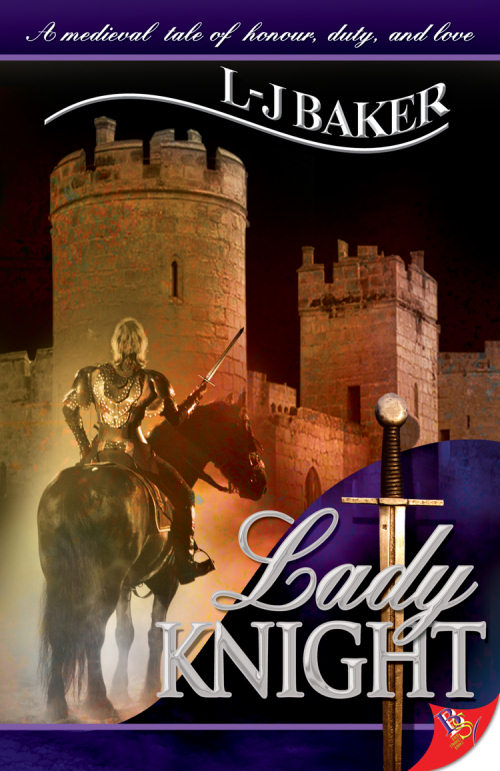
Lady Knight by L-J Baker

Lady Knight by L-J Baker

Bold Strokes Books, Inc., 2007.


Overview: Lady Knight is set in a pseudo-Europe where Crusaders for a religion with four gods have to contend with the infidels’ magic swords, and Riannon, a lady knight—who is often criticized for not being much of a lady—and Eleanor, a beautiful, witty, and wealthy widow, can fall madly in love. While this book, more than any other I have read so far, doesn’t meet our criteria of books where being gay isn’t an issue, the main characters are all positive about it, including the one who has to come to terms with her sexuality, which softens the hate from the minor characters a bit.

My reaction: This was a pretty good read. I was a huge fan of the romance, which was front and center for the majority of the book, and was so desperate for them to end up happy together that I actually couldn’t make myself read the last quarter of the book for a little while. That said, the romance is really all that sucked me in. I had a problem with the religious crusade that, while engineered by a somewhat unsavory lesbian high priestess, was left essentially un-criticized. The “infidels” were basically reduced to plot devices with tattooed faces and swords that could cut through armor without even touching the victim, and while I understood that she was a product of her times, I resented Riannon’s unquestioning participation. While it annoyed me on one hand that we didn’t get much world-building detail about the history of the war between the infidels and the “not-Christians” (I read the book, but don’t really know that there was a name for the collective religion of the four gods…), it’s probably for the best in the end since what there was irritated me. More love and sex scenes than war scenes? Sure, I’ll take it! 

Thendara House by Marion Zimmer Bradley


Thendara House by Marion Zimmer Bradley.
 DAW Books, 1983.

Overview: While this is the sequel to Shattered Chain, which I read first, expecting some lesbian action (or at least main-character romance), it could probably be read as a stand-alone novel. Neither is very long, however, so I would recommend reading Shattered Chain first for the full backstory which is recapped in bits and pieces in its sequel. Magdalene Lorne, a Terran Intelligence agent, was raised on Darkover, where she was one of only a handful of Terrans immersed in Darkovan culture. In Thendara House, Magda, who became a sworn Renunciate (or Free Amazon) in Shattered Chain, goes to the Thendara Guild House to complete her six months of training. Renunciates swear an oath not to depend on men for protection, to not marry religiously, not to bear children except in her “own time and season,” to defend herself with force if attacked by force, that all women under the oath will be her sisters, and more. Even the better part of this book is more focused on Magda’s struggles with her training and her oath-mother (that is, the woman who took her oath) Jaelle’s increasing disillusionment with her partner, Peter Haldane, who also happens to be Magda’s ex-husband. Eventually, however, Magda has to come to terms with her sexuality.

My reaction: For the most part, I really enjoyed this book. Following Magda and Jaelle’s experiences of culture shock, and watching interplanetary politics unfold kept me occupied even as I wondered whether this book, too, would not qualify for a review. World-building for the sake of world-building can drive me crazy, but I love it when it is done well. While the reader learns a lot about Darkovan and Terran etiquette, habits, and mores, every detail feels well-integrated into the plot. I do wish Magda hadn’t been quite so uncomfortable with her lesbian sisters and her own sexuality, but I’ll cut her some slack since the Terran Zone is apparently pretty homophobic. I also admit that after I started really rooting for one relationship, it was a little hard at first for me to accept another one. My only other misgiving—and this is pretty major—was the demonization of men. Bradley doesn’t make all men villains, but Jaelle determines, based on her only heterosexual relationship, that men in general, not just Peter, will feel the need to “possess” her. Ugh. I know the patriarchy exists, but it’s not a biological drive! I think that she figures that out at the conclusion, but THAT squicked me out in a way that I can’t discuss without spoiling it. If you’re a fan of world-building, though, I definitely recommend it.

Saturday, March 23, 2013

Murder Undercover by Claire McNab


Murder Undercover by Claire McNab
The Naiad Press, 1999

Overview: Australian Security Intelligence Organization agent Denise Cleever’s undercover assignment as a bartender on an exclusive resort island is about to get interesting. There to investigate the Aylmer family, resort owners with possible ties to a seedy underworld, Denise is floored when Roanna Alymer, the family’s only daughter, begins to take an interest in her. Can Denise infiltrate the Alymer family without blowing her cover or losing her heart?

My Reaction: Murder Undercover is a perfectly entertaining, light, fluffy and fun book and I mean that in the best way possible. It’s short enough to read in an afternoon on the beach (or when you’re trying to catch a break from writing a lengthy research paper) and the kind of fast-paced, suspenseful story that’s hard to put down. Sexuality is never an issue; Denise is out on the first page and even Roanna’s rich family has no problems with their daughter pursuing women. Though Denise’s personal life remains a large focus of the narrative, McNab never lets the mystery fall too far below the surface. Though I can’t say I was completely surprised by the ending, I enjoyed the ride that got me there. If you are looking for an enjoyable, escapist read set in an Australian paradise and staring a sexy blond detective, I have some good news for you!  

Denise Cleever Thrillers:
Murder Undercover, 1999
Murder Understood, 2000
Out of Sight, 2001
Recognition Factor, 2003
Death by Death, 2003
Murder at Random, 2005

Saturday, March 16, 2013

The Daughters Trilogy by Katherine V. Forrest


The Lesbrarian is in crunch time with grad school, so I am writing a doozy of a review of this trilogy for the entertainment and edification of whoever might be out there reading. Also, it took me four hours in total to read the last book, and probably not much longer for the first two (and that’s just because reading in the lunchroom can be hard, not because they’re any longer), so it just made sense to lump them all together into one review. 

Daughters of a Coral Dawn
Originally published by Naiad Press, 1984. Reprinted by Alyson Publications, 2002.

Overview: The first few chapters of this "lesbian cult classic" (so christened by the cover of its sequel) details the genesis of half-human/half-Vernan nonuplets (Wikipedia tells me that’s a word!), and the nine girls’ development into prodigies in various fields. Of course, each girl also has the time to give birth to a healthy number of offspring, and at the point where the story really takes off, the “Unity” has just over 6,000 members in 5 generations. Since they are a brilliant and attractive lot, and have the use of Estrova, which allows two women to produce female offspring without the help of men, nothing is stopping them from abandoning Earth for coral pastures on a planet they dub Maternas. Not all of them are willing to leave, of course, but around 2/3 of them do, and successfully develop a lesbian utopia.

My reaction: This book was a light, fun read for the most part, especially in comparison to its sequels. It sounds like a pretty nice place to live in general, but while I’m into really smart and sexy ladies and enjoy reading about them, the author’s treatment of the few men who enter the storyline was a real downer. While I am fully aware that some men are super sexist or through their inaction let SuperSexists make spaces unsafe for women, the contention that it is in their nature (at least as I read it)/a utopia could never include men really irked me. Also, this book wins for the Most Unnecessary Ellipses in a Sex Scene!! *applause* It’s not like they’re used to censor it—it goes on for pages in detail! Wet moss isn’t necessarily a sexy descriptor to me, but hey! It’s a fun read-aloud…;)

Daughters of an Amber Noon
Alyson Publications, 2002.

Overview: The sequel to Coral Dawn is really more of a parallel to it, as it follows the harrowing adventures of the Unity that remained on Earth. As a result of the rise of the dictator Theo Zedera—a.k.a. Zed or Premier Supreme—who represents his worldview instead of a country as he rises to power with the help of laser fire that can precisely annihilate entire cities without the poison that accompanies nuclear weapons. The Unity develops a pretty amazing subterranean society neighboring a volcano that they engineer, and we also see maybe a few too many meetings with the Premier Supreme/thoughts of his Supreme General.
My reaction: Okay, so this one was compelling enough that when I woke up in the middle of the night I couldn’t stop worrying about it for at least half an hour. (It felt like that, anyway!) There’s just something about fighting for survival in a dystopia that gets me every time. HOWEVER (without spoiling) the conclusion really disturbed me. If the gender essentialism of Coral Dawn was too much for you (and I confess, it wasn’t for me, just because I focused on the good parts and threw the rest out with a bowl of salt), then STOP DO NOT PASS GO DO NOT READ THIS BOOK. It makes me sad to say this, because on the whole the gripping sense of danger made it a good read, but ugh, the conclusion. It was well-executed, I guess, and tied the book together, but I did not like the idea.


Daughters of an Emerald Dusk
Alyson Publications, 2005.

Overview: The Unity is reunited on Maternas, but an inexplicable tragedy has been going on for the 30 years that happened for the 3 Terran years of Amber Noon: the third and fourth generations born on Maternas have refused to speak after age two, and then leave around age five to live in the rainforest like animals. Joss, whom we meet on Earth in Amber Noon, has multi-orgasmic adventures as she discovers why.

My reaction: In my opinion, this is the strongest book of the trilogy. Riveting mystery? Check. Human drama? Check. Lots of lesbian love (and sex)? Check! It also makes you think about the ecological impact of any large group of people, even if they are extremely conscientious about taking care of their environment. It’s a little weird at times, but that really goes with the territory of most sci-fi. 

Saturday, March 9, 2013

Gossamer Axe by Gael Baudino


Gossamer Axe by Gael Baudino
Penguin Books, 1990.


Overview: Gossamer Axe tells the story of Chairiste a woman born in sixth-century Ireland who is separated from her lover, Siudb, after seeking out new musical knowledge from the bard in what I started describing to the Lesbrarian as fairy hell. After discovering the nature of said fairy hell, Chairiste is able to use the bard’s own best harp to escape, but she does not manage to bring Siudb with her. We enter the story after Chairiste has spent two centuries plotting and occasionally attempting Siudb’s rescue, which has led her to Denver in 1987, where a portal to fairy hell awaits her assault. Through a harp student, Chairiste—who goes by Christa in modern-day Denver—discovers rock and roll and metal, and recognizes that they are her best hope for saving Siudb. As you can guess, this is a very music-driven book, so if lots of descriptions of music will bore you, this might not be the book for you.

My reactionWhile I wasn’t expecting too much from this book, I was sucked right in. Two centuries of longing for and attempting to rescue a lover? I ate it right up. I’m not even a metal fan, but I was inspired to actually listen to what Baudino described as some of the more “rarefied” stuff—Malmsteen’s “Black Star” was Christa’s introduction—and discovered somewhat to my surprise that I liked it. (Here’s Malmsteen’s “Black Star”: http://www.youtube.com/watch?v=XNOa5Gjh2lc ).  I definitely giggled in a few places that I don’t think I was supposed to, and the unusual number of typos in the second half were sometimes a bit irritating, but overall I was invested in Christa’s fight to save Siudb, and supporting characters’ struggles with their own demons of homophobic/rocker-phobic parents, a sexually abusive father, and drugs. Without trying to spoil anything too badly, I was kind of upset by Christa’s apparently magical vagina which, through (in my opinion) blissfully hardly-described sex allows for the “rebirth” of a male partner. I guess I can grudgingly accept it on a re-read, though it came dangerously close to “I’ll have sex with you because I owe you” for my taste, even though he’s a good friend. On the upside, it doesn’t affect her love and devotion to Siudb in any way. If anyone has any reactions to that plotline (or any others!) I’d be happy to hear them in the comments. Despite my quarrels with it, I stayed with the musical magic/star-crossed lovers elements to the end, and if you can get into a battle-of-the-bards type novel, I recommend it!

Saturday, March 2, 2013

The Child Garden: a Low Comedy by Geoff Ryman


The Child Garden: a Low Comedy by Geoff Ryman
Unwin Hyman Limited, 1989. First U.S. Edition: October 1990.

Overview: While this book certainly lives up to its subtitle with its “low” humor, the overarching tragedy of a society that made itself into a dystopia in its efforts to become a utopia transmutes the comedy into pathos. The world of Child Garden is literally sick with too much empty knowledge, as children and adults are inoculated with viruses that educate them while severely impeding their ability to learn independently. The Consensus, an organic network of nearly every citizen’s personality imprint, allows Milena Shibush, one of the few lesbians left in the world (queerness is “treated” upon entry to the Consensus), to grow up apart from it due to her resistance to the viruses. She falls in love with a Genetically Engineered Polar Woman (essentially a polar bear on the outside) who is a brilliant composer, and devotes much of her life to producing and directing her lover’s score of Dante’s Divine Comedy.  (While that is a gross oversimplification of this book, much more explanation would give away major plot-points and conclusions.)

My reaction: This is a bizarre book, in a mostly good way. I really enjoy dystopic novels in general, and this one introduced some twists on the genre. Instead of erasing the past (in the mold of Brave New World, 1984, Fahrenheit 451, etc), the Consensus is stuck reproducing the culture of the past. Actors have to replicate performances as precisely as possible until even they are bored out of their minds, viruses “teach” people to identify all available music thereby precluding a chance to enjoy it for its emotionality rather than its technical elements, and so on. It is also interesting to see a generally well-intentioned dystopic system that accidentally shortened the life-span of its subjects, killed art while trying to help everyone access it, and regrets its mistakes. The result is that the Consensus (which is distinct from the adults whom it represents/controls) becomes an object of pity for the reader, and is a fascinating and sympathetic character. In fact, I think that this complexity is one of the book’s greatest strengths, for as the reader gains more insight into its vulnerability and self-awareness, the tragedy is heightened in a way that it could not have been had the Consensus been thoroughly evil.  
While one of the more “out-there” plotlines was a little difficult for me to slog through (though I was trying to read it in a crowded lunchroom at work, which didn’t really help) for an hour or two, it was worth it for the part that it played in the amazing conclusion. In fact, I may go back and re-read that section for that reason. All told, this is definitely one of the stranger books I’ve read, but I’m glad I did.
*I teetered between "recommended" and "decent"--I guess I'll go with "recommended" for people who have a taste for both dystopias and weirdness, but for myself the "pretty good" definition attached to "decent" was more accurate.

Saturday, February 23, 2013

Sing the Four Quarters by Tanya Huff


Sing the Four Quarters by Tanya Huff
Daw Books: 1994

Overview: Ex-princess turned bard Annice has the rare gift of being able to communicate with all four elements through song instead of the usual one or two. However, she has gotten herself into a tight spot by getting pregnant against the king’s express orders, then helping the father of her unborn baby, the Duc of Ohrid (accused of betraying the kingdom of Shkoder) escape from prison. A foul plot is afoot and Annice and her lover Stasya are thrown into the midst of political intrigue that runs deeper than either had imagined. This is the first book in a series of four.

My reaction: If you like political intrigue, magic, elemental spirits, music and a feisty heroine, this book is a fun read. Annice is technically bisexual (she does sleep with the Duc, after all), but it seems pretty clear that Stasya is her main partner. The world in which they live is populated with a number of other queer characters, both male and female. On a completely different note, I don’t think I have ever read a book in which the main character has to pee quite so often, though I suppose that is only realistic, since she is pregnant almost the entire story. In summary, hooray for kick-ass, powerful, pregnant princess-bards!

The Quarters Series:

Sing the Four Quarters, 1994
The Fifth Quarter, 1995
No Quarter, 1996
The Quartered Sea, 1999

A Grave Talent by Laurie R. King

A Grave Talent by Laurie R. King
St. Martin’s Press: 1993

Overview: The first in a series of five, A Grave Talent follows the personal and professional life of San Francisco police detective Kate Martinelli as she works on her first high profile case with her slightly hard-boiled police partner Alonzo Hawkin. Three young girls have been murdered in a disturbing way, and evidence seems to point to a famously reclusive painter living under the radar in a back-to-the-earth planned community outside the city. While solving the case, Kate must come to terms with her own privacy about her personal life.

 My Reaction: I know I said that I don’t particularly want to cover coming-out novels, but I’ll make an exception for this one, partly because Laurie King is one of my favorite authors of all time and partly because that while Kate is not out professionally, she is in a loving relationship with her partner Lee and seems to have worked out her identity in her personal life. It was a little annoying that King doesn't use any pronouns to describe Lee until about half-way through the book, which is meant to make Kate’s home life a bit of a mystery, but her eventual coming out to Hawkins is handled gracefully and sympathetically. Some of her quieter moments with Lee are downright sweet, though they do have a couple of issues they will no doubt need to work out in future books (but why else, but for a little drama, do we read?). Though I can tell that this is Laurie King’s first published book, the story is engaging and full of good action scenes. Overall, it’s just a damn good mystery with the added bonus of a queer detective!

Read the Bookwhisperer's review of the next Kate Martinelli book, To Play the Fool.

Kate Martinelli Series:
A Grave Talent, 1993
To Play the Fool, 1995
With Child, 1996
Night Work, 2000
The Art of Detection, 2006